
Giving Claude the Keys to My Xbox
Tim Potter
Designer, maker and co-founder of Little Thunder
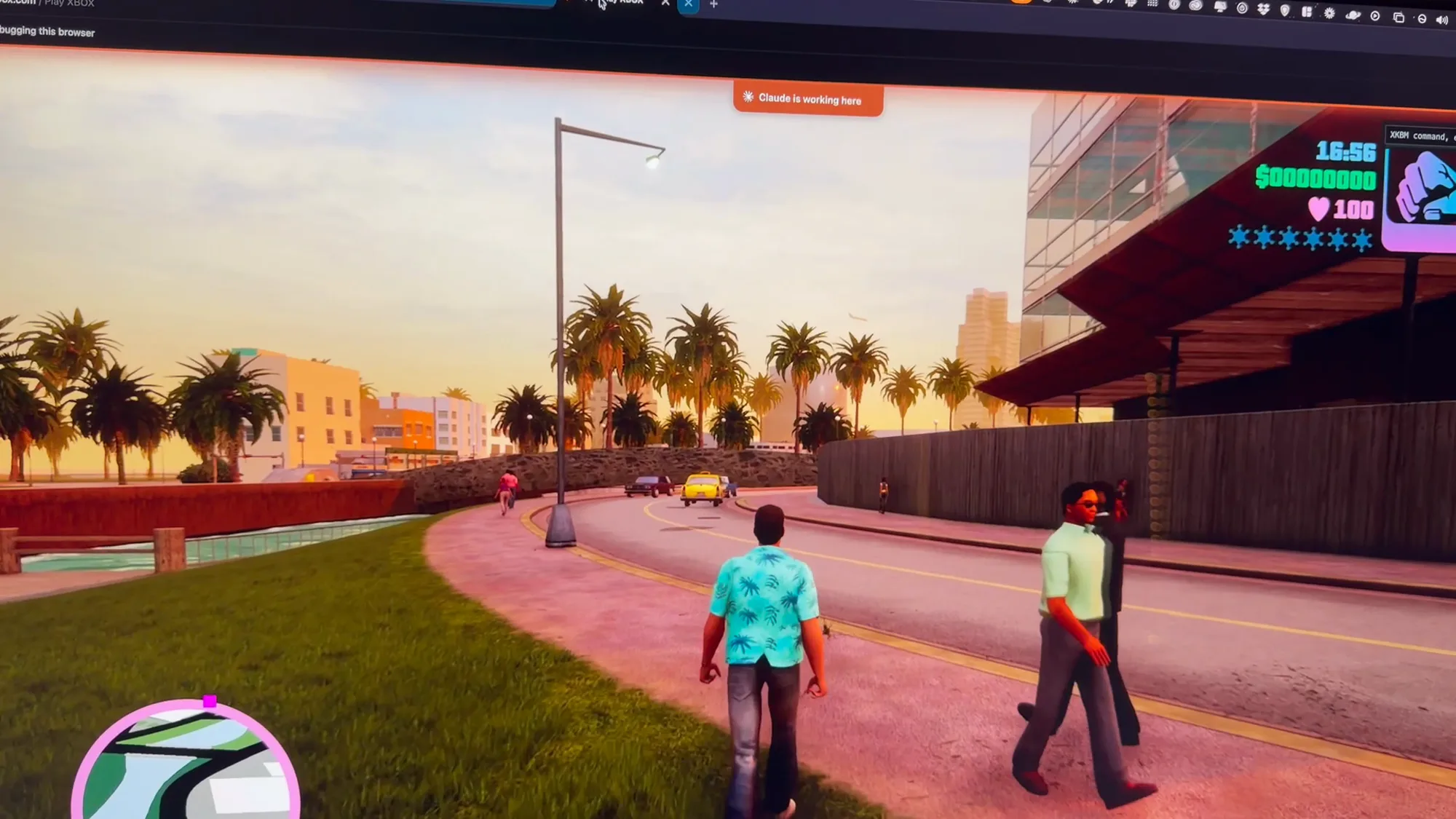
GTA 6 landed last week, so I started Claude somewhere easier. Vice City, running on a real Xbox Series S, driven through Remote Play and a Chrome extension to interface the console to AI.
GTA 6 came out last week.
Naturally, I decided it was time to hand the controller to an AI model. Dropping one straight into a brand new open world felt a little unkind though, so I started it somewhere easier.
Somewhere smaller. Somewhere slower. Somewhere it has almost certainly read a thousand walkthroughs of.
Vice City.
The Setup
There is no API for an Xbox. There is no developer mode that lets a model send button presses to a console. So the whole thing had to be built out of parts that already talk to each other.
The console is a real Xbox Series S, sitting under the telly where it normally lives. It streams to a browser tab over Xbox Remote Play, which is the same feature you would use to play from a laptop in another room.
That browser tab is the seam. Once the game is a web page, it is something a model can reach.
So I wrote a Chrome extension. It started life as a keyboard and mouse layer, turning WASD and a mouse into a virtual Xbox controller the Remote Play player reads as a real pad. Adding AI control to it was mostly a matter of exposing that same virtual controller to the page, so anything running JavaScript in the tab can press a button.
From there, Claude Opus 5.5 drives it through Claude in Chrome. The loop is about as simple as it sounds:
- Take a screenshot of the stream.
- Work out what is happening.
- Send an input, like accelerate for 1.5 seconds while steering left.
- Take another screenshot and see what that did.
The orange badge in the corner of the video below is Claude in Chrome telling me it has the tab. Any real key press or click of mine takes control straight back, which turned out to be a more reassuring feature than I expected.
It Was Very Slow
I want to be honest about this, because it is the most interesting part.
It is painfully slow.
Every single action costs a screenshot, a round trip and a decision. That is a few seconds, every time, before anything happens on screen. A human playing GTA makes dozens of micro-corrections a second without thinking about any of them. Claude gets one thought roughly every traffic light.
So there are long pauses where Tommy just stands in the road while the model works out what it is looking at. In the clip above I have cut most of those out. The real footage has a lot more standing around in it.
And it could not really drive.
Steering is a continuous, constant-feedback problem, and a model that sees the world as a series of still images every few seconds is doing the equivalent of driving by flicking the headlights on once a second. It would set off in roughly the right direction, drift, overcorrect, and clip a kerb. Pedestrians were not safe. Neither were canals.
I added some helpers to close part of the gap, small functions that read Tommy’s arrow off the minimap and steer for a few hundred milliseconds at a time, so the model could say “head east” rather than “left stick, 40% for 300ms” and let the page handle the twitchy bit. That helped. It did not make it good.
What it could do was everything that is not twitchy. Walking. Looking around. Deciding that the dark sedan parked on the corner was the right car. Opening the door, getting in, pulling away. Those are judgement calls at a pace it can actually work at, and watching it make them in sequence is genuinely strange.
What I Actually Take From This
It would be easy to file this under “AI can’t play video games” and move on. I do not think that is the lesson.
The lesson is that the bottleneck was never comprehension. Claude knew what it was looking at. It understood that it was on foot, that it needed a vehicle, that the thing by the kerb was a vehicle, and how you get into one. The understanding was fine.
What it lacked was a fast enough loop.
Which is a constraint I recognise from every other place these models get used. We tend to judge them on what they know, when a lot of the real-world limit is how quickly they can see the result of what they just did and adjust. Give a model a slow feedback loop and it will look stupid at a task it understands perfectly well.
The other thing worth saying is that none of this required permission from anybody. An Xbox, a feature Microsoft shipped for playing in another room, a browser tab, and about two hundred lines of extension code. No console was modified. No API was granted. The console has no idea any of this happened; as far as it is concerned, somebody with a controller was playing badly.
That is usually the fun bit of a project like this. Not that it worked well, because it absolutely did not.
Just that the pieces were all sitting there, already pointing at each other, waiting for somebody to notice.