
The Internet Is Becoming a Graveyard for Ideas
Tim Potter
Designer, maker and co-founder of Little Thunder
When anyone can build anything in an afternoon, ten people will have the same idea and all ten will ship it. A look at multiple discovery, the collapsing barrier to building, and why the hard part is no longer making the thing.
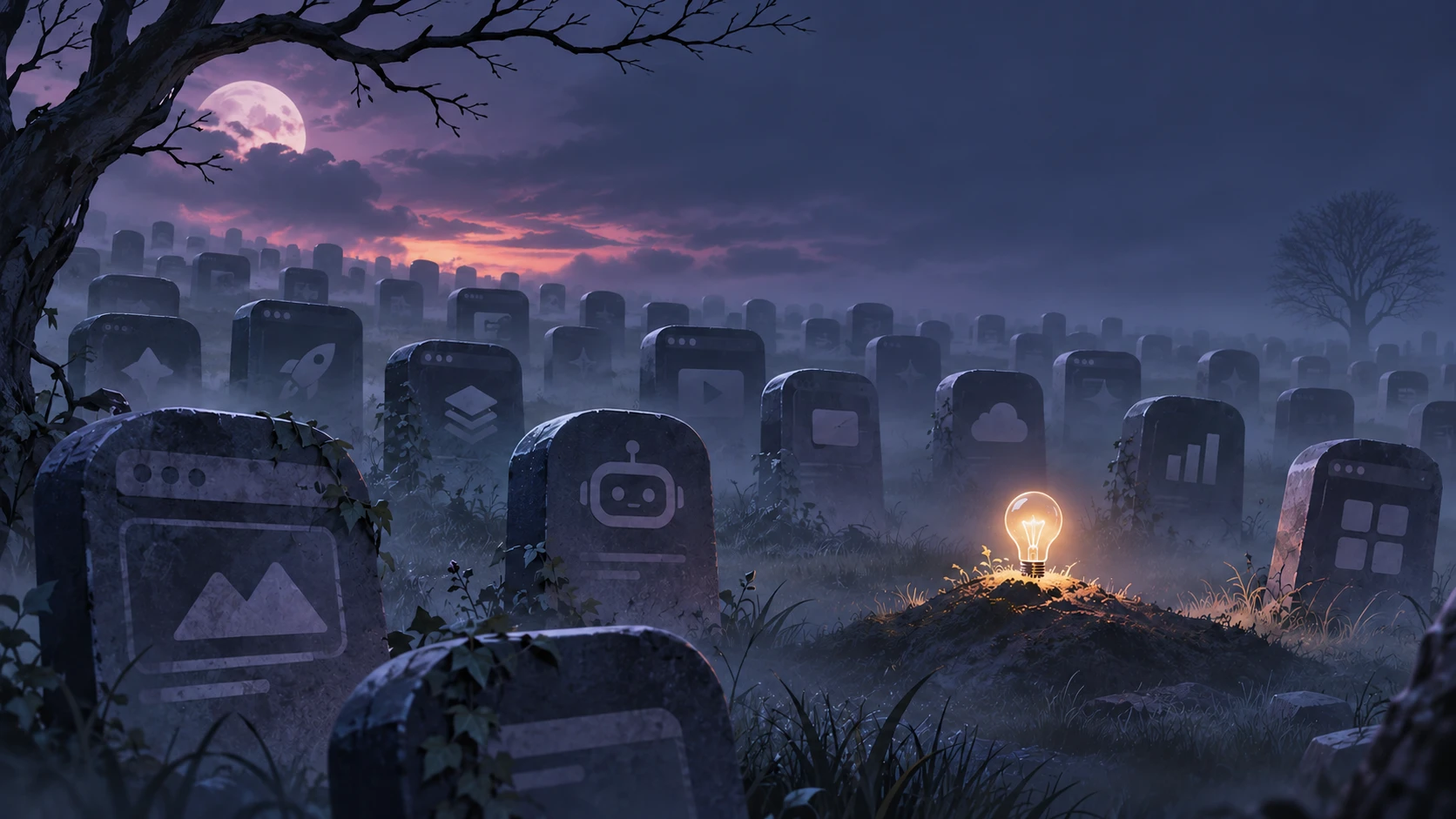
Somewhere on the internet right now there is a finished product that nobody will ever open.
It has a landing page. It has a logo, a pricing table and a working signup form. It isn’t broken and it isn’t bad. It just never got found.
Multiply that by a few thousand a day and you have the internet we are currently building.
A graveyard.
We’re entering an era where you can turn an idea into a working product with little more than a prompt. Apps, websites and software that once took months to develop can now be knocked together in an afternoon.
And naturally, we’re seeing an explosion of them.
But here’s the thing. Your brilliant idea probably isn’t yours alone.
Historians have a name for this. Multiple discovery. In 1922, two sociologists catalogued 148 inventions and theories that had been arrived at independently, by different people, at almost the same moment. Newton and Leibniz both developed calculus. Bell and Gray filed for the telephone on the same day.
Different people, same idea, same moment in history.
The difference today is speed.
When building something required months of development, technical expertise and real money, there was a natural barrier to entry. Ten people might have the same idea, but only one of them would get it built.
That barrier is disappearing.
So what happens when ten people have the same idea and all ten can ship it over a weekend?
What makes one survive while the other nine quietly join the graveyard?
Part of it is taste. Knowing which problems are actually worth solving, and making something that doesn’t look and feel like everything else that shipped that week.
But the less glamorous part is distribution. Getting the thing in front of people and giving them a reason to care.
Taste is the part builders enjoy. Distribution is the part we skip, and it’s the part that decides.
I’ve felt both of these on my own projects. MegaWord worked as a game within weeks. Then I spent four months on things nobody had asked for: animated backgrounds, an original soundtrack, and a pass on spacing that nobody will ever consciously notice. The gameplay took weeks. The spacing took days, and the spacing is what made it feel real.
Building it was never the hard part. Making it worth finding was.
For years, the ability to actually build something was the competitive advantage. That advantage is now available to everyone with an AI subscription and some free time.
The barrier is shifting from being able to build something to being able to build something that matters.
Which is where human creativity, taste and judgement become more important, not less.
Because the graveyard isn’t filling up with bad ideas.
It’s filling up with good ones that nobody visited.