Claude Design, Google Stitch and why design is most certainly "not cooked"
Tim Potter
Designer, maker and co-founder of Little Thunder
The launch of Claude for Design and Google Stitch sparked another wave of "design is cooked" takes. I think the opposite is true. AI is raising the baseline, but it's also making taste, judgement and original thinking more valuable than ever.
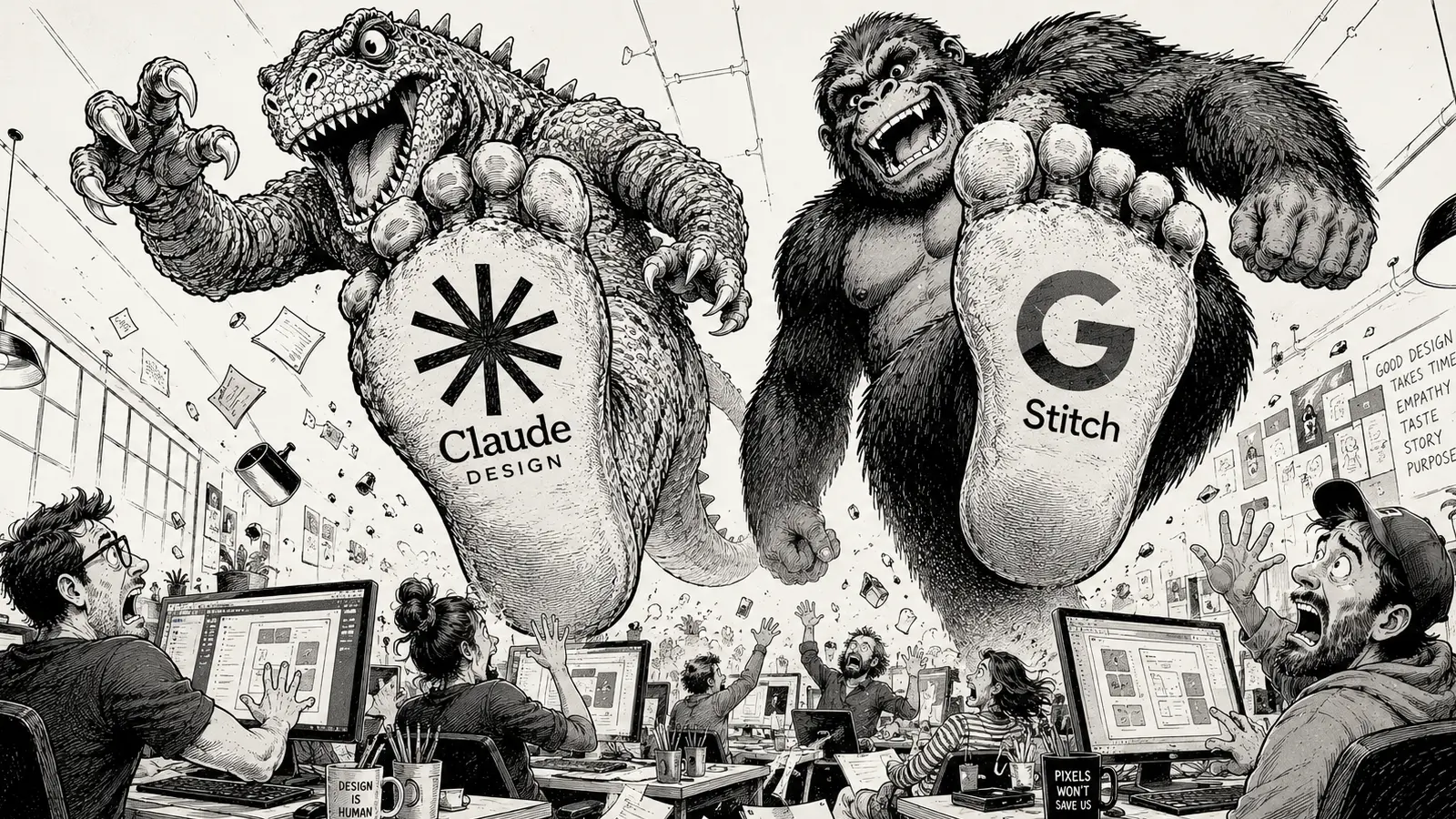
When Anthropic launched Claude for Design and Google unveiled Stitch, the reaction across the design industry felt immediate and familiar.
Excitement. Curiosity. Panic.
Within hours there were already posts claiming UI/UX design was finished. That developers were next. That AI could now generate interfaces, layouts, prototypes and code faster than entire teams.
And honestly, I understand why people react that way.
The outputs are impressive.
You can now describe an interface in plain English and watch AI generate a functioning starting point in seconds. Workflows that previously took days can suddenly happen almost instantly. For clients and businesses looking for speed, that’s incredibly appealing.
But I also think a lot of the conversation around tools like Claude Design and Stitch misses something important.
They’re changing execution far faster than they’re replacing creativity.
Personally, I think this is one of the most exciting moments to be a creative.
AI is a superpower. Not just a tool for rewriting emails or summarising documents. The more you experiment with it, the more possibilities you unlock. I use it daily for copywriting, research, SEO tasks, coding and general creative exploration. As someone working across design and front end development, AI has helped fill in gaps that would have previously slowed projects down massively. It’s opened the door to backend development work that would have taken far longer for me to learn traditionally.
More importantly, it’s become something I can bounce ideas off. A way to sanity check concepts, explore creative directions and remove friction from the process.
That part matters.
Because the real value of AI, at least to me, isn’t replacing creativity. It’s accelerating it.
Tools like Stitch can generate a functional UI quickly. Claude can help structure components and workflows in ways that genuinely improve productivity. But none of these tools know why a product should feel a certain way. They don’t understand emotional nuance, cultural context or the subtle human instincts behind memorable creative work.
They generate. Humans decide.
Some of the projects I’m working on today simply wouldn’t have happened without AI. Things like experimenting with an AI drummer bandmate for music production or creating homebrew games for the Sega Mega Drive, a console released nearly 40 years ago. These were ideas that lived mostly in my head before because the barriers to execution were too high.
AI lowered those barriers.
That’s incredibly powerful.
At the same time, I also think people ignoring the impact on the industry are being unrealistic.
Lower end creative work is absolutely being disrupted. Basic websites, generic branding and production-heavy tasks can now be created in minutes for very little cost. When tools like Claude Design can rapidly scaffold interfaces and generate code alongside them, it’s obvious that parts of the industry will change permanently.
For clients wanting something quick and functional, AI-generated work is often “good enough”.
And that changes things.
Good enough is becoming the new baseline.
I think that’s where a lot of the panic online comes from. People see AI generating decent visuals, layouts or code and assume that means creative roles disappear entirely.
But creativity has never just been about producing assets.
AI is trained on human work. Human trends. Human taste. Human culture. Those things constantly evolve because people evolve. Design trends change because humans push them forward. Music changes because humans experiment emotionally and culturally. Creative breakthroughs happen because someone sees the world differently.
That human side still matters enormously.
The feeling of working with someone who genuinely understands your vision, your audience or your goals can’t really be replicated by AI. Empathy, interpretation and emotional understanding still sit at the centre of meaningful creative work.
If anything, I think tools like Claude Design and Stitch make those qualities more valuable.
When anyone can generate something visually acceptable in seconds, the differentiator becomes judgement. Taste. Perspective. Originality. Knowing what to make and why.
Not just how quickly you can make it.
I especially think junior creatives are entering the industry at a strange time. The old path of slowly working through repetitive production tasks is changing rapidly. But I don’t think the answer is rejecting AI completely.
I think the answer is embracing it while developing skills AI struggles to replicate.
Learn how to use these tools well. Experiment constantly. Understand where they help and where they fall short. But also build your own perspective. Find a niche. Develop taste. Learn how to communicate ideas clearly and work with people effectively.
Because there are very few true experts in AI right now.
We’re all learning this in realtime together.
ChatGPT only exploded into mainstream awareness in 2023. Since then the pace has been relentless. New tools launch weekly. Models improve constantly. Entire workflows change overnight. Claude Design and Stitch are just the latest examples of how quickly the landscape is shifting.
Nobody has fully figured this out yet.
And honestly, I think that’s what makes this moment exciting.
The creatives who thrive in the next few years probably won’t be the ones resisting AI entirely, or blindly relying on it for everything.
They’ll be the people who understand where human creativity still matters most.
Taste. Judgement. Empathy. Direction. Storytelling. Knowing when something feels right.
AI can generate endless variations, but it still needs someone to decide what is meaningful, what connects and what deserves to exist in the first place.
The barrier to entry is lower now. Good enough is everywhere. That simply means creatives have to push further, think deeper and develop a point of view that can’t be copied from a prompt.
The tools have changed. Creativity hasn’t.